Ancient Persia
What is today known as the Middle East is where the ancient Persian empire was based. King Cyrus is the best known of all Persian kings. We will relate the legend of King Cyrus. Cyrus is well known as an exemplary king, for several reasons. He was interested in people and their cultures. He did not just conquer lands, as other kings did, but develops a way to rule over his people that was more generous. The ideas of King Cyrus relate to more democracy. His thoughts on how to govern a kingdom are some of the oldest ideas similar to modern democracy. Thomas Jefferson, who was instrumental in the creation of the modern United States of America, was inspired by the ideas of King Cyrus and modern democracy has a debt to him. The biography of King Cyrus will be narrated, and some of his ideas about how to rule a kingdom discussed. In the first activity, students will be asked to form their own kingdom. Do they want to run it like King Cyrus did? Students will write down the key rules of their new kingdom.
Ancient Persia is also known for its gardens. The word ‘paradise’ comes from a Persia word used to describe some of these gardens. Students will be introduced to some features of Persian gardens, including irrigation and water mills. For another activity, students will design their own gardens, which will include means for irrigation.
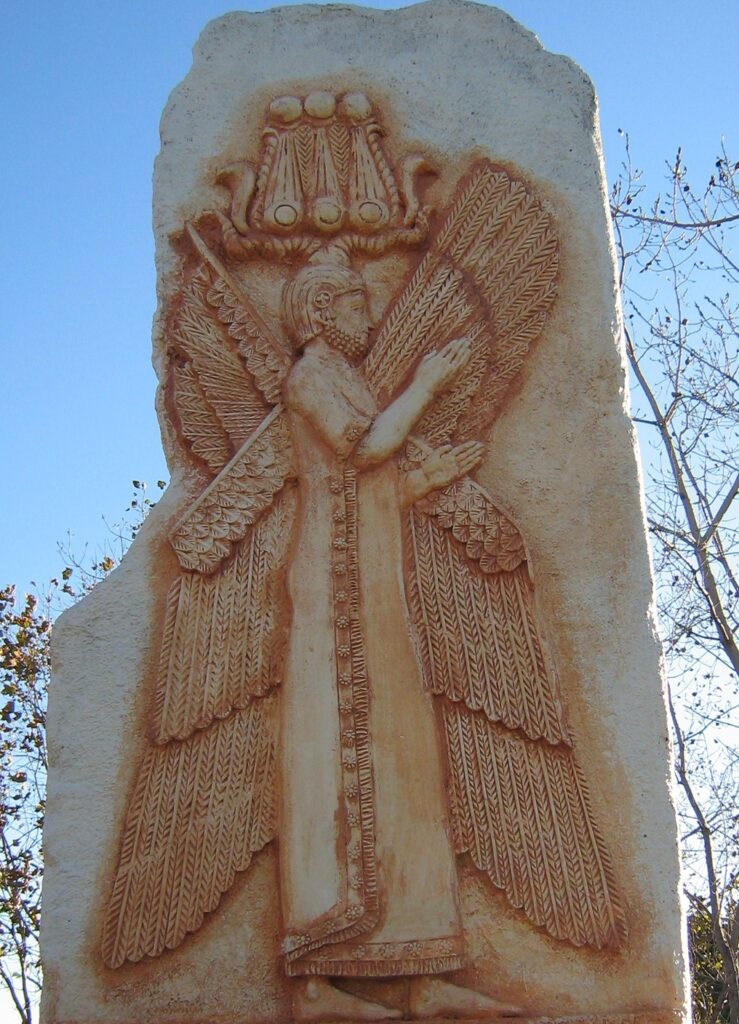
A four-winged guardian representing King Cyrus (reproduction)
Curriculum for Excellence subjects and skills:
SOC 2-01a: I can use primary and secondary sources selectively to research events in the past.
SOC 2-17a: I can describe the main features of a democracy and discuss the rights and responsibilities of citizens in Scotland.
EXA 2-07a: I can respond to the work of artists and designers by discussing my thoughts and feelings. I can give and accept constructive comment on my own and others’ work.
RME 2-09: I can explain why different people think that values such as honesty, respect and compassion are important, and I show respect for others.
National Curriculum subjects and skills:
History: The achievements of early civilizations. Understanding significant aspects of the history of the wider world, the nature of ancient civilizations, understanding continuity and change.
Geography: Naming and locating some of the worlds’ continents and oceans, using basic geographical terms such as river, valley, sea, ocean, port, mountain, forest, city, town, village. Engaging with maps.
Citizenship: Learning about democracy, and about an ancient king from Iran who was one of the first to have ideas about democracy, which have helped to shape modern democracy in the USA and UK.
English: Drafting and writing with appropriate grammar, use organisational devices like bullet points.
Art: Improving students’ mastery of art and design techniques.